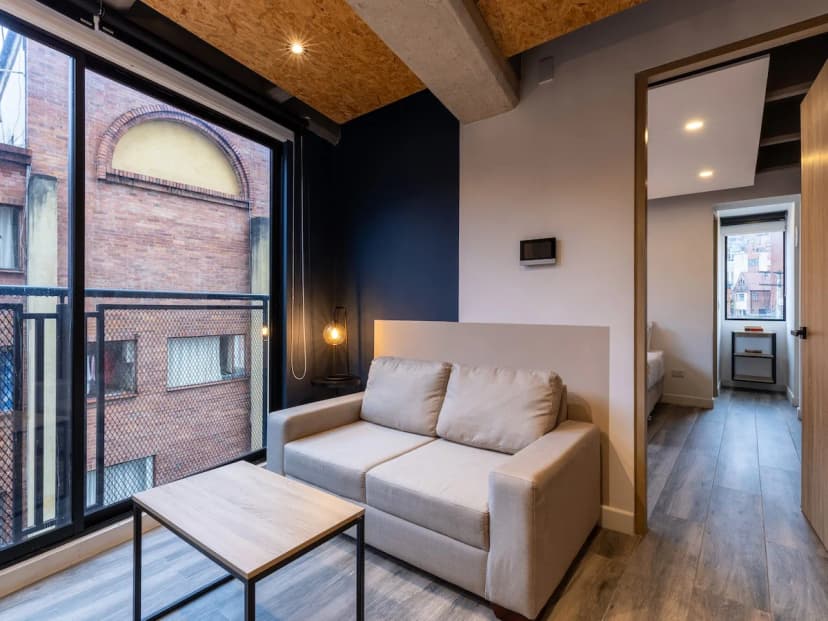
Chic Loft Apartment in Chapinero BogotáN°001
Bogotá, Colombia
 Photo by Random Institute on Unsplash
Bogotá spreads across a plateau at 2,640 metres in the Colombian Andes, a city of eight million where colonial La Candelaria, world-class museums and one of Latin America's most exciting dining scenes meet a backdrop of cloud-forested peaks. A private residence in the city's leafy north gives space, security and a concierge to unlock it all.
One of the world's largest performing-arts festivals fills Bogotá's theatres, streets and plazas with companies from across the globe in even-numbered years.
Bogotá's international book fair is one of the Spanish-speaking world's most important literary gatherings, drawing authors and readers by the hundreds of thousands.
Latin America's largest free rock festival, held in Parque Simón Bolívar since 1995, anchors a series of free 'al Parque' festivals spanning jazz, salsa and opera.
The city's summer festival brings concerts, kite flying and open-air sport to Parque Simón Bolívar during Bogotá's August holiday season.
Bogotá switches on elaborate light displays across parks and avenues, with Novena gatherings and festive food making December a warmly atmospheric month.
The most reliable skies of the year for Monserrate and savanna day trips, opening with December's Christmas lights and Novena traditions.
Afternoon showers keep the plateau emerald while FILBo, the great book fair, and the start of the free 'al Parque' festivals fill the cultural calendar.
A second dry stretch brings Rock al Parque, August's Festival de Verano and kite season on the city's parks and hills.
Bogotá's indoor riches come into their own: long museum mornings, specialty coffee crawls and the dining scene at full strength before the festive season.
Bogotá runs north to south along the base of the eastern Andean ridge, and altitude of another kind orders the city: the further north, the leafier and more residential. La Candelaria, the colonial core, holds the museums, government palaces and university life. The centre-north neighbourhoods carry the best of daily living: Chapinero Alto and the Zona G for dining, Zona Rosa (Zona T) and Parque de la 93 for shopping and nightlife, and Usaquén, once a separate village, for its Sunday flea market and stone church square. Luxury stays cluster in these northern districts, in gated residences and penthouses with mountain views, where quiet streets and building security make an easy base. Our concierge arranges drivers, guides and reservations, the keys to moving through Bogotá comfortably.
Start in La Candelaria: the Museo del Oro's astonishing pre-Hispanic goldwork, the Botero Museum's donated collection of the artist's rounded figures alongside his Picassos and Monets, and streets layered with some of Latin America's best street art, well seen on a guided walk. Ride the funicular or cable car up Monserrate for the full sweep of the city from 3,152 metres. On Sundays, join the Ciclovía, when main avenues close to cars and the city cycles, runs and strolls together. Day trips reach the Salt Cathedral of Zipaquirá, an underground church carved in a working salt mine, and Lake Guatavita, source of the El Dorado legend. Coffee tastings, emerald shopping with a trusted expert and Andean birdwatching in the cloud forest above the city round out a stay; the concierge arranges each with vetted guides and drivers.
Bogotá has grown into one of Latin America's serious food capitals, its top tables regularly ranked among the region's best and a generation of chefs reworking Colombia's extraordinary biodiversity, Pacific seafood, Amazonian fruit, Andean tubers, into refined tasting menus in the Zona G and Chapinero. Traditions hold their ground: ajiaco, the capital's chicken, corn and potato soup with guasca herb; tamales with hot chocolate on weekend mornings; and cheese-topped chocolate santafereño for the brave. Usaquén's Sunday market and the city's fruit stalls introduce lulo, guanábana and feijoa, while Colombia's finest coffees are treated with reverence in specialty cafés. A private chef at the residence, arranged through the concierge, brings the country's produce home.
Sitting almost on the equator at high altitude, Bogotá has no summer or winter, only a perpetual cool spring: days around 18 to 20 degrees, crisp nights year-round, and sunshine that turns quickly, so layers are the local uniform. The drier windows run roughly December to March and July to August, the most reliable months for Monserrate views and savanna day trips. April, May, October and November bring more rain, usually in afternoon bursts that clear. December is festive, with Christmas lights across the city, while cultural life peaks around events like the biennial theatre festival and August's Festival de Verano. Whenever you come, allow a gentle first day: the altitude asks for it.
El Dorado International (BOG) is one of Latin America's busiest and best-connected hubs, with direct flights from Madrid, London, Paris and across the Americas, and it doubles as the natural gateway to the rest of Colombia, from Cartagena to the Coffee Axis and Medellín. The airport lies west of the city, roughly 30 to 60 minutes from the northern residential districts depending on traffic, which is a genuine factor in Bogotá planning. Private transfers arranged by the concierge are the recommended arrival, and a car with driver remains the most comfortable way to move around the city and out to Zipaquirá and Guatavita on the high savanna.